Estimated reading time: 7 minutes
I learned to play tennis as a kid and returned to it as an adult with the help of an Aussie tennis coach named Ted. I had no particular talent; I just wanted to play with family and friends.
I was eager to learn his secrets for hitting shots that win points at the net. Instead, he started by training me, again and again and again, to get into the ready position before each shot.
It was so basic and obvious that I was annoyed. But Ted wasn’t bothered by that. He said people who stand in the right spot on the court, in the right stance, dramatically increase their chances of returning the ball. “You’ll be consistent and stay in the game.”
His charming Aussie accent helped me get over it and do what he said. Improving my odds of returning the ball didn’t require skill and felt doable. And it worked. I stayed in the game, became more confident, and had more fun.
There’s a ready position for writing your family story, too. Before you start your family story project, take some time to find yours.
This is the starting point for our Foundations Series, designed to help you get ready for your family story project using the Storykeeping® method.
What I Ask My Workshop Writers to Do
5 Steps to Find Your Family Story Ready Position
Most people I work with aren’t professional writers. They’re recreational writers, working on a project for their family and themselves. They’ve never had a reason to think about what helps them write. Maybe that’s the case for you, too.
Your ready position is the set of practices that help you return to your writing again and again. There’s no one-size-fits-all formula, but some practices tend to support most people. I’ve designed five steps to walk you through them. I call these the Storykeeping Foundations. Try them to find what works for you. Only you can know that because you are the expert on you.
Step 1: Begin With a Pen and a Notebook
When you are starting, your goal is to get a few words on the page, then come back and do it again. I ask all family story writers to try writing by hand because it’s often easier to jot down a few words on paper than it is on a screen. On paper, you’re less likely to feel the urge to polish, and more likely to write in your natural voice. When your family reads your story, I want them to “hear” you.
Keep all your writing in one place by setting up a Family Story Notebook. A simple structure helps you find what you need when you need it, and that alone can ease some of the overwhelm many people feel at the start.
If you try writing by hand and it truly doesn’t work for you, ask yourself why. If it’s because writing by hand is difficult for you, set up your notebook on your computer instead. Having one home for your writing will make it easier for you to return to your project.
Step 2: Try a Dedicated Writing Spot
Where you write can change what you write. The right spot is different for everyone, so experiment beyond the place where you usually answer emails and do other work. Maybe the kitchen table feels distracting, but the dining room table feels quiet and connected. Four questions will help you find the family story writing spot that feels right for you.
Step 3: Know Why You’re Writing
Your family story might feel too big to write. Knowing specifically why you’re writing makes it smaller. Your why guides you every time you sit down to write. It tells you who to write about and which piece of the story to write next. Then you’ll write that one little piece in a format I call a Slice, which is no more than two pages (and it can be as short as a paragraph). Here’s how to decide what to include in your family story, starting with a two-minute activity to find your why.
Step 4: Decide When You’ll Write
Knowing why you’re writing also helps you find the time to write your family story. You need less time than you think: 15 minutes reserved on your calendar to work on one tiny piece of your story. That might be jotting down what you know about the place your mother is from, your grandfather’s experience in the war, or why the framed photo of your grandmother matters so much to you. Once you start, more words may come to mind as you go about your life. Write them down when they do. Then, come back for another 15 minutes.
Step 5: Find What Keeps You Coming Back to Your Writing
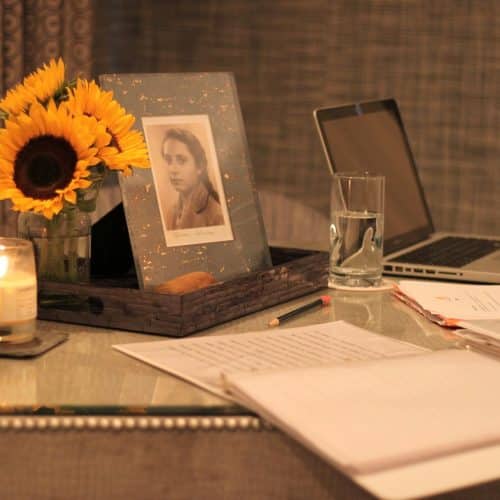
Some family story writers find that a small, meaningful action helps them settle in to write and also makes it easier to come back and do it again. This could be holding a family object that’s meaningful to you, looking at a family photo, or lighting a candle to bring a sense of sacredness to your work. Many use their ritual to step into the past when they begin and to come back out when it’s time to stop. Here’s how to find a family story writing ritual that’s right for you.
All family stories hold something painful. Losing a parent or grandparent. Leaving a home or country. War. Illness. Financial difficulties. A falling out. Being kind to yourself can bring comfort in the moment and may even help you include more feeling words in your story. Here’s a simple way to be kind to yourself when writing your family story.
What Supports Your Family Story Writing?
Keep experimenting and notice what supports you. It may be something unique and personal. For one of my family story writers, Virginia, it was listening to her grandmother’s music box when she sat down to write. It carried her back to the Buenos Aires apartment where she played it as a child, and made it easier to write about that time.
Your ready position dramatically increases your chances of staying in the game and having fun. That matters, because family stories come from consistent work, no matter how small.
Ready to Begin? Pick an Entry Point
When you’re ready to put words on the page, start with our First-Timer Storykeeping Series. It gives you a small writing task and walks you through it step by step. You’ll start by gathering what you already know about your parents and grandparents in one place, then choose one way into your writing from the entry points below. Go with whatever feels easiest.
Frequently Asked Questions
FAQs
Find a few personal practices that help you begin and return to your writing. I call this your ready position. In five steps, you can explore the practices that work for most writers. They are: 1) write with a pen in a Family Story Notebook; 2) try a dedicated writing spot; 3) know why you’re writing; 4) spend 15 minutes on one small writing task; and 5) find what keeps you coming back, including a personal writing ritual and being kind to yourself when the story is painful. Try each one and keep what works for you.
Less time than you’d think. You can set up a Family Story Notebook in one sitting, find your why in two minutes, and reserve 15 minutes on your calendar to write this week. Your ready position for writing will evolve and grow with you. Learning about yourself and what supports your writing is part of the writing process.
No. Getting ready and writing happen side by side. Set up your Family Story Notebook, then take your pen and notebook to a writing spot you think will support you. Spend two minutes jotting down why you want to write. Your why helps you choose the small piece you’ll work on in your first 15 minutes. A writing ritual develops over time, as you keep returning to your writing. And use a kindness practice whenever you need it.
No. Most people I work with aren’t professional writers, and many have never written about their family before. What matters most is capturing what you know about your family in your natural voice, the way you tell a story out loud. This way, your family can “hear” you when they read your story.
That’s useful to know! When something doesn’t work, ask yourself why, because the answer often points to what will. These five steps support most writers, but your ready position is personal. One of my writers found that listening to her grandmother’s music box helped her settle in to write. Keep experimenting. You’re the expert on you.
Photo credit: Jack Belisle