Estimated reading time: 5 minutes
This post is part of our Long Story Short series where we share family story Slices written using the Storykeeping method.
When you begin a family story project, you need a way in: a narrow focus that helps you get a few words that matter to you onto the page.
Don’t start with a chronology of a person’s life. Begin with “My grandmother was born on…” and you’ve got decades ahead of you to cover. That’s overwhelming.
Instead, begin with something physical, like a family place. Describe it, then jot down why it matters to you.
The why is key. It takes you below the surface and helps you grab hold of memories that have feeling. Often a roadmap of what to write next will appear.
Family story writing is less about reporting facts and more about discovering what your family story is really about.
For Gena, the way in was the little white house in Kentucky that belonged to her great-grandmother Ida Mae. She’d gone there many times growing up with her grandmother, Mary Agnes.
Using the Storykeeping method, Gena wrote her story in Slices, short writings of two pages or less. She wrote about the house outside, then inside, room by room. Along the way, pieces of the family’s life emerged: what happened there and what it felt like to be there.
Here’s the Slice Gena chose to begin her family story. I like how her children can read this and journey back in time with their mom to their great-great-grandmother’s house.
The Little White House
By Gena Greer
“I will always remember the little white house as the center of my connection to Bath County and the family that grew up there…”
Traveling to Salt Lick, Kentucky, with my grandmother, Mary Agnes Sexton (“Mamaw Sexton” to me), was always a joy. Weekends at my house could be fairly mundane, especially if Mom worked the weekend shift; so if Mamaw Sexton asked if I wanted to go to Salt Lick, the answer was a loud “YES!” I was always up for an adventure, no matter the distance or the task.
Our first stop would be to see her mother, my great-grandmother, Ida Mae Wells Maze (“Mamaw Maze” or “Ida Mae”). Her little white house sat on US-60 about 10 feet from the heavily traveled, 2-lane road into Salt Lick, Kentucky, just a few miles from I-64.
Mamaw Sexton: Details, Only the Best
Mamaw Sexton was a serene, gentle, particular woman. She never raised her voice and was always quietly smiling. She insisted that if something is going to be done, it be done right.
My brother, Joe Dan, learned the ways of agronomy, taking care of the soil and grass, from her and has gone on to own a hugely successful golf course construction company. He often heard, “Details, only the best, or don’t even try.”
At all times, Mamaw Sexton’s lawn was mowed within an inch of perfection, and her rose bushes meticulously manicured. While I didn’t take to the outdoors as well, I learned the art of sewing from her. Every seam was perfect, or it was removed and sewn again. She was just as particular about her appearance as she was about her lawn. Her hair was always expertly rolled and coiffed. I think the “particular” gene is identifiable and has been passed on through the generations to my father.
Mamaw Maze: Smiles and Snuggles
Mamaw Maze, on the other hand, never said too much as she had greatly mellowed in her old age. She would just sit and smile.
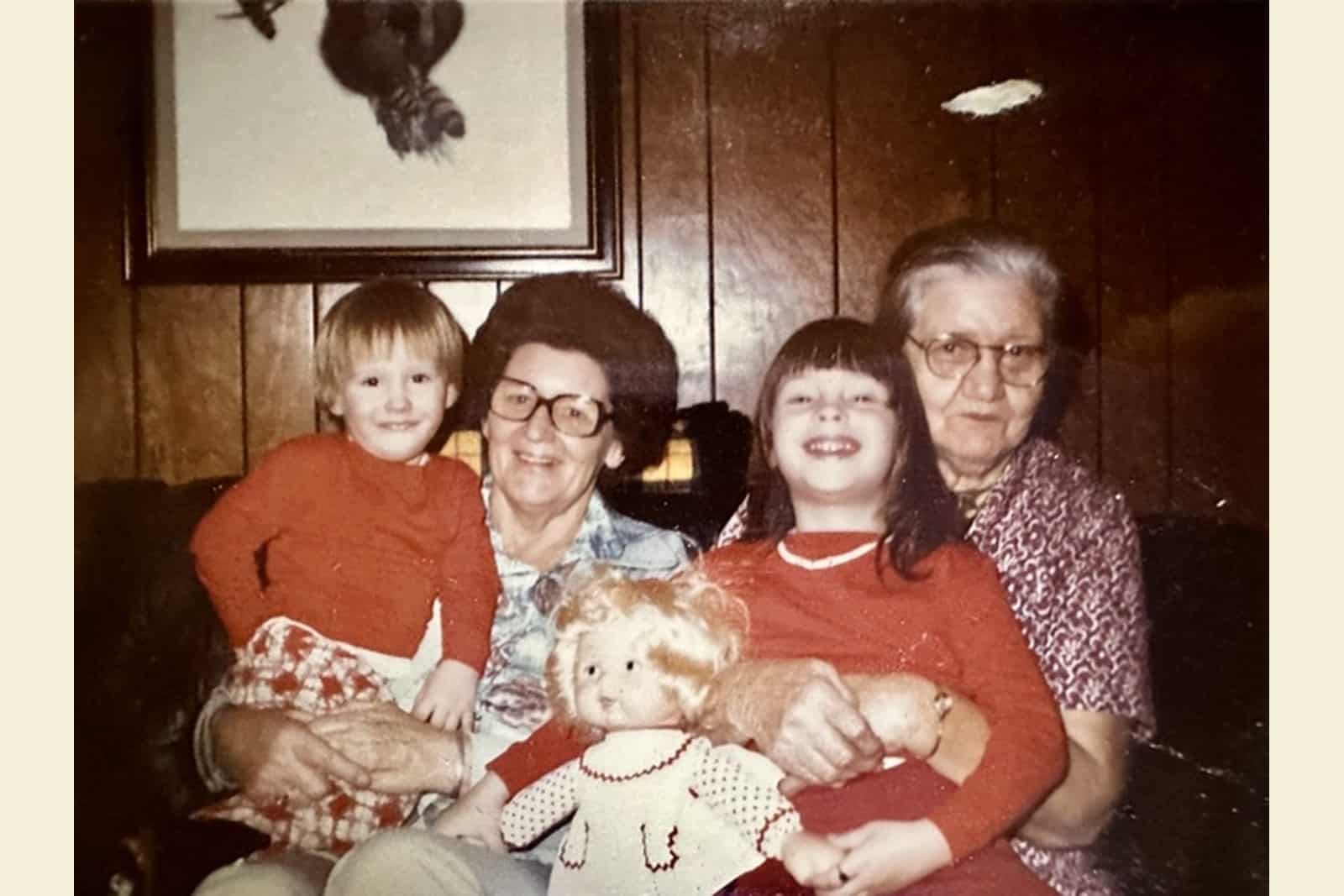
She was a big woman, 6 feet tall, with large arms and hair past her waist. It was never cut; she just didn’t believe in haircuts. We would bring her to Lexington a few times a year to visit. One of the activities would be to wash her hair outside on the porch in a large washtub. Drying and rolling it up in a tight bun on her head would take another hour. What a job!
Mamaw Maze had a drainage issue with her right arm that would cause it to collect fluid, making her appear even larger to my young mind. She sure knew how to wrap those arms around your waist and snuggle you close to her in her chair. I loved these two women with all of my heart.
The little white house was sold after Mamaw Maze’s death in 1982. Today, it is no longer recognizable as the structure it once was: it is a little less white, a little less tidy, and now adorned with Irish green trim. No matter, I will always remember the little white house as the center of my connection to Bath County and the family that grew up there, those that I knew and so many that I didn’t.
“I Had Questions!”
My interest in the Maze-Wells family story began years later during a May Term writing class called The Washington Experience at Transylvania University (Lexington, KY). We took the Amtrak Train to Washington, DC, and while there, we wrote about the sights and sounds around us as we visited as many monuments, parks, and museums as we could see in a week.
At The National Archives, my assignment was to look up a family member from the 1900 census and write a story about their life. I chose Ida Mae. The census told me that she was living on a farm with her father, mother, two sisters (Ollie and Eddie), a brother (Ben), and 28 “inmates” of various ages who had the “profession” of pauper. I had questions!
Is a place that matters to you coming to mind? See How to Start Writing Your Parent’s Story With Places
Photo courtesy of Gena Greer, used with permission.