Estimated reading time: 8 minutes
You want to write a family story. Maybe it’s about your grandmother or grandfather, mother or father. Or all of them. The problem is, you just can’t make it to your chair to write.
I have a photo of myself as a toddler seated on my mom’s lap with my grandmother, great-grandmother, and great-great-grandmother. They’d all married and had children young, so there was a time when we were all in the same room together. Wow.
I’d long wanted to write their stories, but I just couldn’t get myself to sit down and write. Something or someone always came first.
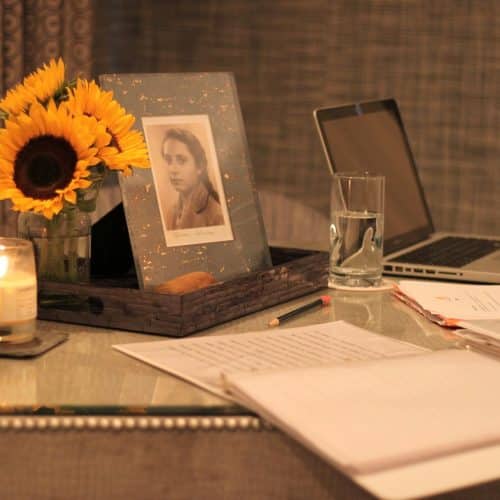
One day, I took out the photo, looked at it closely, and felt like I was back in my grandmother’s house as a young girl, listening to the women in my family talk. I reached for a pen and paper and jotted down a few words. In the weeks that followed, I did it again and again and again. At some point I realized that looking at this photo had become my writing ritual.
A ritual can help you make it to your writing chair. Here’s how to find a family story writing ritual that works for you.
This series will help you get ready for your family story project using the Storykeeping® method.
A Simple Definition
What Is a Family Story Writing Ritual?
A family story writing ritual is a small, meaningful action you repeat before you jot a few words on the page. It’s not as elaborate as it sounds—in fact, the easier and shorter the better. You can simply hold your grandfather’s passport or the locket your mom gave you.
A ritual can help you move beyond feelings lurking in the background that make it hard to write. I wish I’d asked more questions. How can I possibly get all of this down? My writing isn’t good enough. Will someone get upset if I write that?
Researchers at Harvard Business School and four other universities, including Columbia and Penn, found that a simple ritual lowered people’s anxiety about a nerve-racking task—measured by what they reported and their heart rates. The ritual also improved how they performed the task.
the 4-Step Process
How to Find Your Writing Ritual
Anyone can have a writing ritual. This 4-step process will help you find one that works for you.
1-Choose a Small Action You Can Repeat
Select a small action that you can do the same way every time you sit down to write. Go through your five senses to get ideas:
- Look at a letter your father wrote or images of your family’s hometown on Google Maps.
- Listen to a song that reminds you of your dad or a voicemail from your mom.
- Smell the Jergens cherry-almond hand lotion that permeated your childhood.
- Taste your grandpa’s peppermint candies or his beloved espresso.
- Touch your dad’s silk scarf or wear your grandmother’s ring.
Smell can be a powerful connector for family story writing. Because of the way the brain stores scent memories, scents can stir decades-old memories and emotions in an instant. Chanel No. 5. Cinnamon rolls. Pipe smoke. Lemon Pledge. Dial soap. The memories may even flutter when you think about the smell.
When I worked with a group of children and grandchildren of Holocaust survivors, many were grappling with the loss of generations, their family photos, and belongings. So their small action was to hold a stone. It reminded them each week that a written family story is tangible and can be shared with the generations that follow.
Choosing your small action is personal. I can give you suggestions, but I can’t tell you what will resonate with you. But if something comes to mind after reading this, don’t overthink it; just do it.
2-Ask Yourself Why Your Small Action is Meaningful
What makes your small action a ritual is why you do it. The same researchers found that the story about the action was the only difference between something with ritual power and something that was just a random action.
That’s why any small action will do, so long as you give it meaning. For example:
- Lighting a candle may bring an elevated or sacred feeling of honoring your ancestors.
- Listening to your dad’s song may separate your writing time from time spent making phone calls, running errands, and answering emails.
- Looking at an extended family photo may signal that you’re doing something purposeful, that’s bigger than yourself.
- Saying your mom’s funny phrase may connect you to the gratitude and love you have for her (even if everything wasn’t perfect).
Some of these reasons may resonate with you, and if so, adapt them to your situation. If not, ask yourself why you feel drawn to the action you have in mind.
Then, every time you take your small action, remind yourself why it matters.
3-Jot Down a Word or Two
After you’ve taken your small action and told yourself why it’s meaningful, follow that with jotting something down. But keep the bar low. You don’t need paragraphs or even complete sentences; if you jot one word, you’ve been successful.
When you write, don’t think about who you are writing for or what they’ll think. At first, write only for you. Remind yourself that it doesn’t matter what you write because no one else will read it. Just jot whatever comes to mind on the page.
4-Use a Ritual to Leave Your Writing Time, Too
When you write your family story, you enter the world of the past. A ritual can help you find your way there, and it can also help you find your way back.
You can use the reverse of your starting ritual to leave your writing time:
- Turn off the music.
- Blow out the candle.
- Say goodbye to your grandmother.
- Put the ring back in the drawer.
Or it can be something different:
- Go out for a walk or head to the gym.
- Call your sister or brother.
- Have a piece of chocolate.
Any small action that closes the door on your writing time works.
A child of a Holocaust survivor writing her mother’s wartime story found that having both starting and ending rituals made her project possible. Knowing she had a way to end when time was up helped her begin.
Get Ready to Write
Prepare for Your Writing Time
Once you’ve chosen a small action and know why it matters to you, set up your ritual before your writing time. Buy the peppermint candies, find the song on YouTube or Spotify, or put the silk scarf in your desk drawer.
I stuck a digital copy of the photo of my mother and grandmothers on the cover of my Family Story Notebook. Take the time to prepare so your writing ritual doesn’t become another recipe for procrastination.
Plan the Time
Keep your writing time short at first. Fifteen minutes total, the first few times. Increase when it feels right, but always go in with an end time in mind and stick to it. This is not only good for your writing, but it makes it more likely that you will come back again and again and again.
Begin and End with Your Writing Ritual
It helps to have an entry point or prompt for your writing. That will narrow your focus and make it easier to come up with a few words. You’ll find entry points at the end of this post.
This is what your writing time will look like:
- Set a timer for 15 minutes.
- Do your writing ritual.
- Write a few words.
- When time is up, put your pen down, even if you’re mid-sentence.
- End with your writing ritual.
Repeat, Repeat, Repeat
Repetition is what makes the writing ritual take hold. It’s what settles you into your family story project.
You’ll know you’ve found it when you feel grounded and can approach your writing even if there are lingering feelings of uncertainty, fear, or doubt.
You’ve found your ritual when you feel grounded enough to write anyway.
What Supports Your Family Story Writing?
A ritual is one of several small things that make family story writing easier. There’s also finding a writing spot to call your own, setting up your Family Story Notebook, and giving writing by hand a try.
Ready to Begin? Pick an Entry Point
You’ve chosen a small action and given it meaning. Now do the ritual and let’s spend a few minutes writing. Our First-Timer Storykeeping Series gives you the prompts for your first words. Each post offers a different entry point to help you start your family story in about fifteen minutes.
Since you’ve been thinking about family members and the objects that connect you to them, try the OBJECTS entry point. If that doesn’t feel right, go with whatever feels easy or interesting. The links below walk you through it, step-by-step.
FREQUENTLY ASKED QUESTIONS
FAQs
No. A family story writing ritual can be as simple as playing your dad’s song, wearing your grandmother’s ring, or lighting a candle. What makes it a ritual isn’t the object, but the meaning you attach to it. And if your family’s past left you with few family photos or objects, you can still build a ritual around anything. Hold a stone to remind you that a written story lasts.
A writing ritual is a small action, meaningful to you, that lasts only a few seconds. It will help you spend less time staring at a blank page and more time writing.
No. A routine is the practical structure around your writing — when and where you sit down. A ritual is a small, meaningful action that helps you cross from ordinary time into your family story writing time. You can have both, and they work well together. A routine is a set of actions, while a ritual gives one of them meaning.
Photo credit: From my family collection.