Estimated reading time: 8 minutes
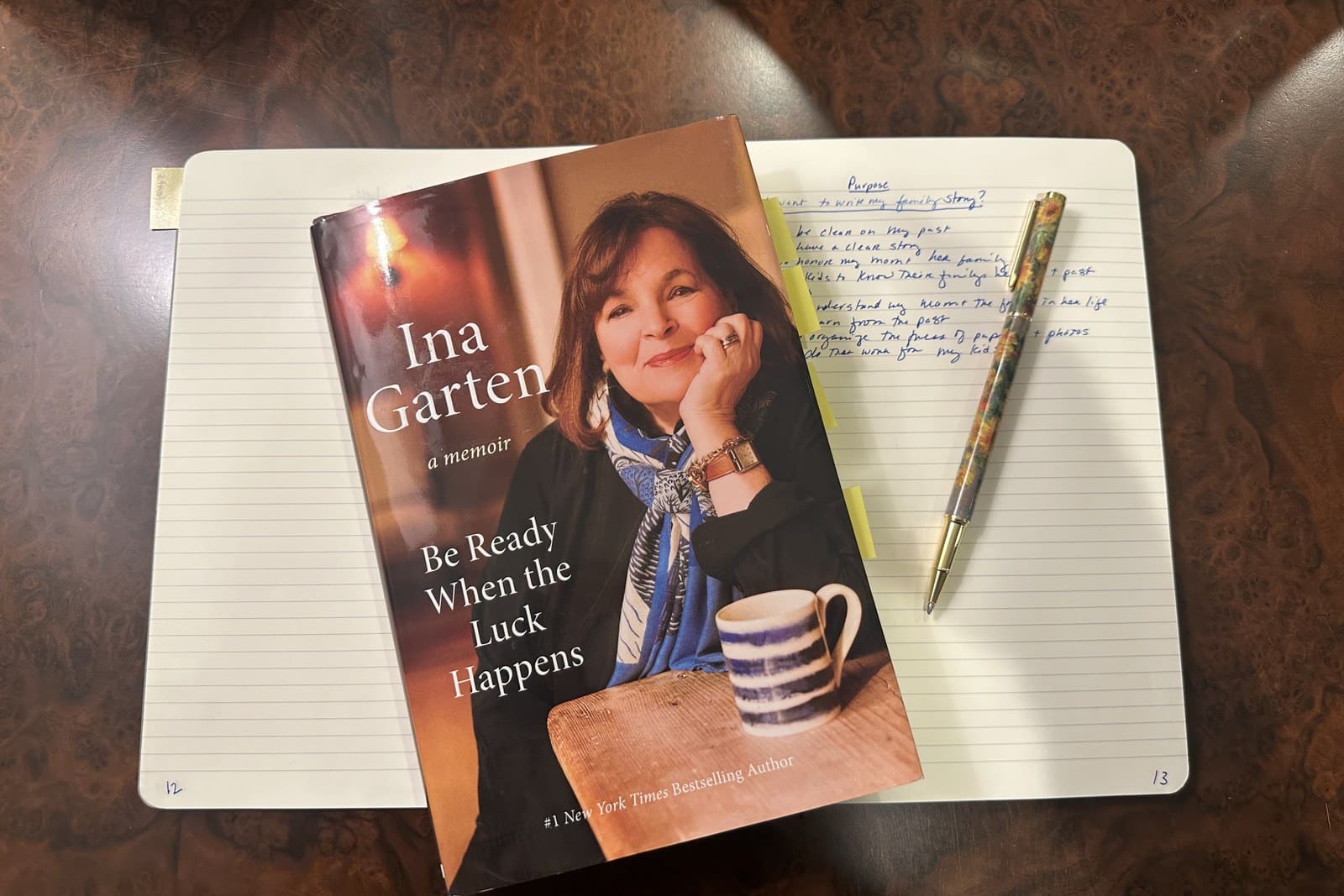
It won’t be interesting. My childhood was painful. I’m scared. These are the kinds of worries I hear from clients when we begin working together. So in some ways, I wasn’t surprised to read in Ina Garten’s memoir, Be Ready When the Luck Happens, that she had the same fears when she began writing about her family and her life.
But Ina learned that her writing project was more than getting words on the page: it was a chance to understand her life. She said writing “turned out to be so much more interesting” than she ever expected. She connected the dots from her grandparents, parents, and the young woman she was to the person she has become today.
I enjoyed reading Ina’s story and admired the way she wrote it. Ina is a master at teaching home cooks how to make simple, delicious food, and she’s applied her cooking principles to writing her memoir. It’s a master class for family story writers.
Here are five family story writing lessons from Ina Garten’s memoir. Use them to start a conversation with your book club or to begin writing your own story.
This post is part of our Family Story Inspiration series, exploring books, films, and other media that can inspire your family story writing.
Learn How to Write By Reading Memoirs
What Ina Garten’s Memoir Teaches Family Story Writers
1. Write the Way You Talk
Ina writes about a time in college when she was away from Jeffrey, and they secretly met for an innocent sleepover at…a motel. Ina puts the words in italics, and I can hear the “oh my!” in her voice.
She piques our interest before she tells it: “I can’t believe I’m opening this door, even a crack, but this story is too good not to share.” How many times have you said something like that before dishing on your younger self? Include the way you’d say it in your writing.
So it turns out that Jeffrey, who was not yet her husband, filled out the registration form for the motel using his parents’ address, then left his pajamas behind in the room. Ina follows that with a parenthetical: (who wears pajamas?!) Jeffrey and Ina were terrified the motel would mail the pajamas to his parents. “The whole episode seems beyond quaint today,” she writes, “but the terror of discovery was real!”
Writing this way lets us sit with younger Ina and older Ina at the same time. We hear the story from both parts of her.
She does this throughout her memoir, in parentheticals and in the text. She questions what her younger self said: “Where did I get that idea?” Or what others said to her: “Really?” She reminds readers of the context: “…but it was the sixties” so they can stay there with her. And at the end of a story where she walked away a little wiser, she simply says: “Lesson learned.”
When you write, put the dictionary and thesaurus aside and start on paper. Imagine you are sitting down with a cup of coffee and a good friend. Laugh at yourself, comment on the times you lived in, and say so when something you did then feels ridiculous to you now.
2. Write About Your Grandparents
Ina writes about her difficult childhood: her angry father, her cold mother. Their harsh, critical voices stayed with her throughout her life, and she explores their influence throughout the book.
But Ina knew the story didn’t start there. It started with her grandparents.
Her mother’s mother, Annette Rich, “to put it politely, was challenging.” Chilly and demanding, she offered no warmth, only harsh criticism. As we learn about Annette, we begin to understand why Ina’s mother was so unloving. She couldn’t give Ina what she never got herself. Through this lens, I imagine Ina feeling some empathy for her mother as she realized the similar thread in their childhoods.
Her father’s mother was another story. Bessie Rosenberg, an Eastern European immigrant, ran two businesses with her husband, Morris: a candy store and a junkyard. Their warm home was “filled with relatives, friends, food, and love.” Bessie was generous and good-humored, always cooking and “happiest when she was feeding people.” Ina even looked like her. When Bessie brought Ina a party dress from Paris, Ina had no idea where Paris was, but “was pretty sure it was a special place” and “wanted to go there someday.”
Sometimes you have to skip a generation to find yourself in a relative. By writing about Grandma Bessie, Ina found so much of herself.
Writing about your grandparents as adults, using their first names, lets you meet the people who raised your parents. You don’t have to know a lot about them. Just a few sentences about Ina’s said a lot. Write down what you know, and you may be surprised to discover connections you didn’t realize were there.
3. Go Back to the Places You Lived
When Ina started writing her memoir, she went back to the house she grew up in Connecticut. Seeing the house brought up the painful feelings she’d felt there as a young girl. It was “like visiting a house of horrors.” At the same time, being there as an adult, she appreciated things she hadn’t remembered, like how pretty her old neighborhood was.
She also visited the homes she’d had in D.C. At the house where she and Jeffrey lived when Barefoot Contessa came into her life, she had “an out-of-body experience.” Seeing the front steps, she remembered sitting there with Jeffrey in 1978, talking about whether they’d stay together. She felt the gravity of that moment, and how critical the choice to stay together had been for her life. Those feelings helped her write an honest story about her marriage instead of a fairy tale.
Try going back to one of the homes you lived in, either in person or virtually using “Street View” on Google Maps, where you can see the house and travel all your old haunts. It may look different to your adult eyes because the place has changed, you have changed, or both. Have pen and paper handy so you can jot down your reaction and how it makes you feel. Places can be a powerful way into your family story.
4. Reconnect and Remember With Family
While she was writing, Ina reconnected with her brother, Ken. She was surprised to discover how similar their memories were, down to the words they used to describe them. She called reconnecting with Ken one of the most extraordinary results of writing her memoir, and said she was grateful to him for “helping me understand what happened to both of us.”
Make a list of questions and reach out to a sibling, aunt, uncle, or cousin you haven’t spoken to in a while. You may enjoy the ease of talking to people who not only know your entire backstory, but were there. Or, you might learn things you didn’t know or couldn’t understand as a child. Clients often tell me that reconnecting with family was one of the most meaningful parts of their writing project.
5. Let Others Help You See Your Own Story
Ina carried a story about her life in her head that went like this: I did what I loved and got lucky along the way.
But others saw it differently. Oprah told her she made her own luck. Sharyn Alfonsi, who interviewed her for 60 Minutes, said her success had come from “hard work, shrewd business sense, and leaving nothing to chance.”
Something about the hard work story didn’t resonate with Ina, but it got her thinking about the role luck and hard work had played in her life. She let it marinate for a while.
Then one night at dinner, a friend told a story about Liza Minelli’s view of her success, and bam! It all came together. She realized her success had come from both hard work and luck. Hard work made her ready when the luck happened. It changed the story she told herself.
You can let others help you see your story, even if you don’t know Oprah. Write by hand for 3–5 minutes in response to this prompt: What story do I carry in my head about my life? Jot down whatever words and phrases come to mind, even if you go off-topic.
Then, take your notes to your computer and write a sentence or two, adding words and editing as you go. Ina’s one-sentence story is your model; try to stick to one or two key ideas.
Finally, share what you wrote with someone you trust: a family member, friend, or your book group after reading Ina’s book. How does what you hear make you feel? If it doesn’t feel right, why not? Let it marinate. Like Ina, when you find the right words, you’ll feel it.
Begin Your Own Family Memoir
Ina didn’t write her story alone. She worked with a writing partner, Deborah Davis. If you’d like a writing partner, I’d love to help. I’ve been helping people write their stories for more than a decade.
Or you can begin on your own today. Set up a Family Story Notebook, and start with a life event or a family heirloom, writing the way you talk. Find time to write by reserving 15 minutes on your calendar, and aim for a few words on the page. As Ina would say, “How easy is that?”
Photo: Safekeeping Stories.