Estimated reading time: 4 minutes
The events of your parents’ and grandparents’ lives are often the backstory of events in your own life. That was true for Allan Rayburn. After writing about the English family who helped his father survive Nazi Germany during World War II, he felt it was time to write about a related, meaningful event in his own life.
By the 1990s, Another Genocidal War Was Raging
Allan wrote: “To put this story in context, the year was 1994. One year after Schindler’s List debuted, one year after my parents began to speak about their experiences, and one year after Elie Wiesel had admonished then-President Clinton at the opening of the US Holocaust Memorial Museum for not helping the Muslims of
Bosnia, as the world stood by and watched another ethnic cleansing/holocaust. I was struggling with how to “pay it forward,” meaning, how would I give someone else what had been given to me by the British families who took in my parents after Kristallnacht?”
The events of your parents’ and grandparents’ lives are often the backstory of events in your story.
Allan happened to catch a short Sunday morning news program interviewing Muslim journalist, Robert Azzi, whose daughter had asked him what he would say at the opening of a future Holocaust Museum for Muslim Bosnian Children. He had no good answer. So, he set out to bring Bosnian children to his town of Exeter, New Hampshire, so they could attend school, receive a good education, and prepare for a day when there would be no war at home.
Allan quickly contacted Azzi, and they spoke at length about their backgrounds and the reasons they wanted to help. It took about a year, but finally, Allan got the call that there was a Bosnian student he and his wife could bring over to live in their home. Allan had found a way to pay it forward.
Here’s the Slice Allan wrote about the day Alma joined his family.
The Day We Met Alma
by Allan Rayburn
We met Alma Muharemagic as she and about 30 other students deplaned at the Boston airport. She was 15 years old, tall, scared, spoke beautiful English, and was exhausted after having just driven with her father for 12 hours. She’d gone from Tuzla, Bosnia, to Zagreb, through the war-torn mountain roads, then flown from Croatia, through Frankfurt to Boston. She had no idea who we were, and had no way to contact her parents to let them know she arrived safely.
She was suffering from survivor’s guilt. Her family was at home in Bosnia during the non-stop shelling, and she was safe in the US.
We stayed the night in Boston and tried to comfort her. Lots of crying that night, all of us, as she tried to put her life back together.
Living With Survivor’s Guilt
We found out later she was suffering tremendous survivor’s guilt, since her younger brother and parents were left at home during the non-stop shelling, and she was safe in the US. The first year was very tough, as you might imagine, all the problems of a 16-year-old teenager with the added horrors of war and non-stop worrying about her family back home.
We knew she’d go back someday, but didn’t want it to happen.
She did very well in school, had lots of friends, was very outgoing, and loved
challenging the teachers. We always instilled in her the reason she was here: her country would need smart, educated leaders when this war was over. We knew she’d go back someday, but didn’t want it to happen.
The War Ended, But Alma Stayed
The war ended, and Alma returned home in 1997. We had, by this time, brought several other Bosnian students to Rochester, some living with us, others living with my brother’s family, and other community members. By this time, Robert Azzi had brought 91 Bosnian students to the U.S., and they all went home after high school.
However, Alma wanted to come back for college, and she entered the University of Rochester. She thrived, getting her bachelor’s degree and then stayed, working for the university while getting her Master’s Degree in international business from the Simon School. Always at the top of her class, always able to bridge the divide between her homeland and the US.
She’s Our Daughter, Her Parents Are Our Family
She is married now, is 43 years old, and lives in Tuzla, Bosnia, with her 3 children. She is the “Brand Lead Immunology for Central Europe and Baltics” for Johnson and Johnson.
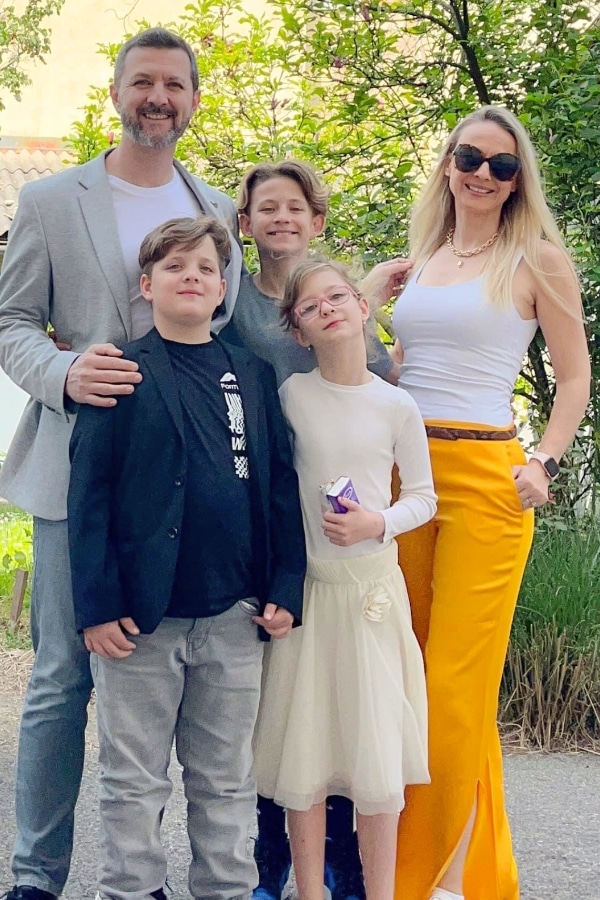
She became our daughter, her parents became our family. We’ve traveled together in the US and through 9 countries in Eastern Europe.
When Alma married in Tuzla, she had 2 sets of parents in the wedding: her birth parents and her American parents. When we visited Auschwitz, Alma was with us, since her family had lost family there also.
We’re most proud that she has chosen to pay it forward by working with Syrian refugees passing through Bosnia toward their trek to Western Europe.
Read more about Allan’s experience writing his father’s story in Writing His Father’s Story Put His Life in Perspective.
Photos courtesy of Allan Rayburn, used with permission.